
Veritas Health Sydney
CPET & VO2 Max Testing
Understand how your body performs under stress
At Veritas Executive Health, our medically supervised VO₂ Max testing uses Cardiopulmonary Exercise Testing (CPET) to examine how your heart, lungs, circulation and muscles respond as exercise intensity progressively increases.
Rather than simply measuring performance, CPET helps us understand the physiology behind it — providing objective data that can be used to assess cardiorespiratory fitness, identify factors that may be limiting exercise capacity and develop a more precise approach to training and long-term health.
CPET integrates cardiovascular, respiratory, gas-exchange and metabolic information during exercise rather than assessing these systems in isolation.
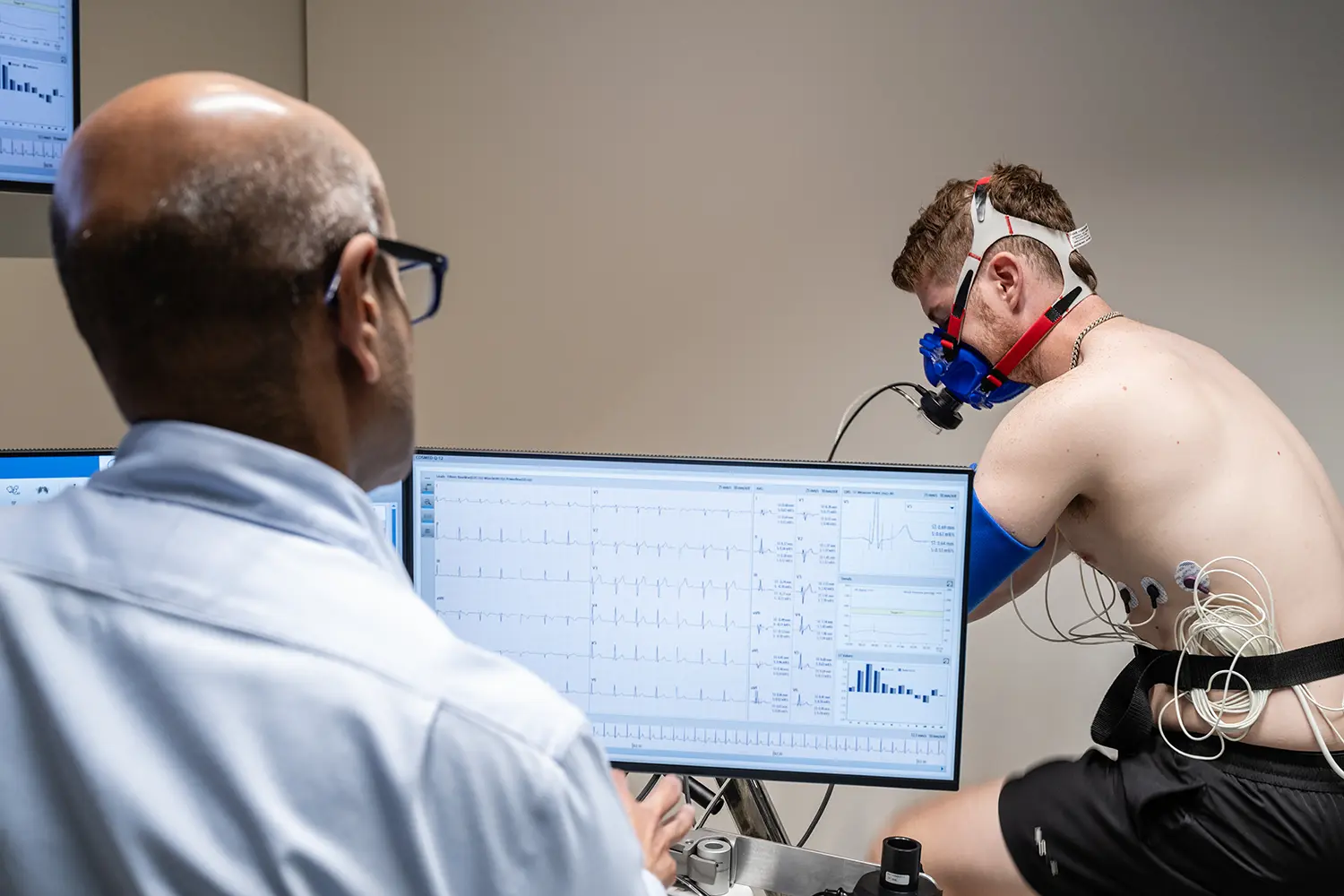
CPET and VO₂ max testing in practice
What happens during a CPET assessment?
Your VO₂ Max test can be performed on either our medical treadmill or professional cycling ergometer, depending on the most appropriate option for you.
During the assessment, you wear a specialised face mask connected to metabolic testing equipment that analyses every breath. At the same time, we continuously monitor key physiological measures including:
- Oxygen consumption and carbon dioxide production
- Ventilation and breathing response
- Heart rate
- Blood pressure
- Oxygen saturation
- Continuous 12-lead ECG
- VO₂ Max and functional exercise capacity
- Anaerobic or lactate threshold
- Respiratory Compensation Point
- Ventilatory reserve and other respiratory parameters
- O₂ pulse and cardiovascular response
- Individual exercise heart rate training zones
VO₂ refers to the amount of oxygen your body consumes and uses to produce energy.
During CPET, the oxygen you inhale and the carbon dioxide you exhale are measured breath by breath while exercise intensity gradually increases. This allows us to directly assess how effectively oxygen is transported from your lungs, through your cardiovascular system and ultimately utilised by your working muscles.
Your assessment measures oxygen consumption (VO₂), carbon dioxide production (VCO₂) and ventilation (VE), alongside your cardiovascular response to increasing physical stress.
Unlike estimates generated by general fitness formulas or consumer devices, CPET provides direct physiological measurements obtained while you exercise.
To help produce a reliable assessment, we recommend avoiding heavy exercise on the day of your test, avoiding alcohol for 24 hours beforehand and avoiding caffeine on the day.
The existing Veritas protocol also recommends fasting for at least two hours before testing.
Your medical team will provide any additional preparation instructions relevant to your individual circumstances before your appointment.
One of the principal measurements obtained during CPET is your VO₂ Max — the maximum amount of oxygen your body can utilise during intense exercise.
It is widely used as an objective measure of cardiorespiratory fitness and provides valuable information about your body’s ability to transport and use oxygen.
Cardiorespiratory fitness is also an important marker of long-term health. Higher fitness levels are consistently associated with more favourable cardiovascular and overall health outcomes, which is why assessing fitness can provide information extending well beyond sporting performance.
For Veritas clients, your VO₂ Max becomes an objective baseline that can be monitored over time alongside the other measures obtained through your broader preventative health assessment.
VO₂ Max tells us about your maximum capacity, but some of the most useful information from CPET occurs before you reach maximum effort.
The assessment identifies physiological transition points including your Anaerobic Threshold, sometimes referred to as the lactate or first ventilatory threshold, and your Respiratory Compensation Point.
These thresholds indicate how your body’s energy production and breathing response change as exercise becomes progressively harder.
Rather than estimating training intensity from a percentage of your predicted maximum heart rate, these measurements allow exercise zones to be based on your own physiological response.
Generic formulas have limitations because two people of the same age can have very different levels of cardiorespiratory fitness and very different physiological responses to exercise.
CPET allows us to determine individualised heart rate training zones using your measured physiological thresholds.
This can help distinguish between the intensity required for aerobic development, endurance training and higher-intensity work, allowing each exercise session to have a clearer purpose.
Research and contemporary CPET guidance also recognise the value of physiological thresholds obtained through CPET when prescribing and adjusting exercise intensity.
Whether you want to improve VO₂ Max, build aerobic endurance, enhance performance or simply exercise more intelligently, objective testing provides a much stronger foundation than relying on estimated heart rate formulas alone.
Exercise places demands on multiple systems simultaneously.
Your lungs must move oxygen into the bloodstream, your heart and circulation must deliver it to working tissue, and your muscles must extract and utilise that oxygen efficiently.
Because CPET examines these processes together, it can provide insight into whether exercise capacity appears to be limited predominantly by cardiovascular, respiratory, muscular or metabolic factors.
This integrated assessment is one of the features that distinguishes CPET from a conventional exercise test.
You do not need to be an elite athlete to gain useful information from a VO₂ Max assessment.
CPET may be valuable if you want to establish an objective measure of your cardiorespiratory fitness, improve exercise efficiency, optimise endurance or high-intensity training, monitor your response to an exercise program, or better understand your functional capacity as part of a proactive approach to healthy ageing.
For performance-focused clients, the results provide precise data to guide training.
For those focused primarily on long-term health, VO₂ Max testing provides a measurable baseline from which cardiorespiratory fitness can be monitored over time. VO₂ Max is the best predictor of all cause mortality risk.